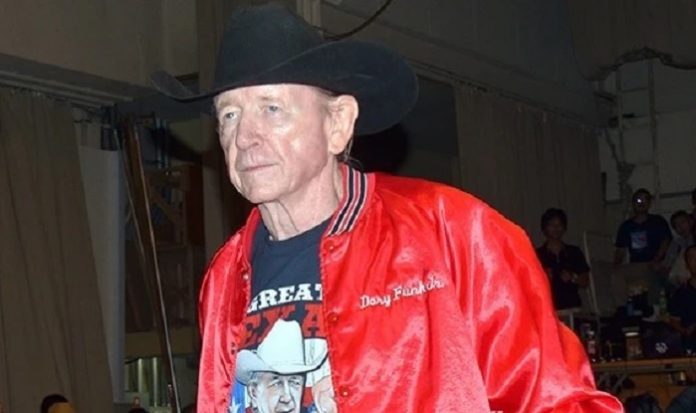
It was with great sadness that I heard that news that former National Wrestling Alliance heavyweight champion, Dory Funk Jr., the technical contrast to his wild brother Terry, passed away yesterday at the age of 85.
Dory, the second-generation mat mechanic, broke into the business in the early-1960s, following his legendary father’s footsteps into the family business. Dory Sr., who promoted the Amarillo territory when Texas had multiple organizations across the massive state, reached legendary status of his own as the “King of the Texas Deathmatch” during his heyday in the ring. Dory Sr. died from a heart attack at the age of just 54 shortly after he retired from the ring in 1973.
Before the end of the decade of his debut, Dory Jr. won the NWA world title, defeating Gene Kiniski in early-February 1969, and kept the belt for nearly four and a half years before he dropped it to Harley Race in mid-1973. That ranked Dory as one of the longest-reigning NWA champions in history and brought along with it the grueling schedule of the traveling champion. The title run, especially in that era when the champion had to be voted on by the collection of promoters under the Alliance banner, cemented Dory a career that spanned an astounding seven decades.
To attempt to parse detail on every aspect would be far too lengthy for one article, book, or DVD collection. However, even the broad stroke on the canvas that is professional wrestling can illustrate just how much of an impact that Dory individually, as well as the Funk family collectively had on the sport on a global basis.
Similar to some of the other “gaijin” or foreigners like Stan Hansen and Brusier Brody, the Funk brothers obtained mythical status in Japan during the 70s and 80s, a true peak for pro wrestling in the country, a time when the fierce, but respectful competition between Antonio Inoki’s New Japan, and Giant Baba’s All Japan led to record crowds, as well as major television ratings for their programs in primetime slots. Dory was an integrate part of that success, working in the office to bring over American talent for Baba’s events. Dory was the technical grappler, while Terry’s hardcore style gave both of them their own unique place in the sport. Dory is known for his crisp uppercuts and slick maneuvers in the squared circle. With as much respect and reverence is held for tradition in Japan, the Funk name still maintains legendary status in the country today.
Dory was such a staple of the NWA territories and Japan before Vince McMahon’s national expansion of the early-80s that his smooth as silk technical style didn’t seem like it would mesh well with the sizzle over substance approach of the WWF. Still, Terry and Dory, renamed Hoss Funk for whatever reason, worked in the promotion for a year after that arrived in 1986, which was probably a wise decision financially since the organization was in the midst of the boom period of the late-80s. Despite the short stint, WWF management knew how skilled he was, and Dory would again play an integrate role in the development of talent, this time in the United States, roughly a decade later.
With more than 25 years already logged in the ring, regarded as one of the top workers of all time, Dory had a reputation that garnered him more work around the world into the 1990s. He worked tours of Japan, Puerto Rico, and even made an occasional appearance in the fledgling Extreme Championship Wrestling group alongside his brother, Terry. The Funks vs. The Public Enemy in a no-rope barbed wire match in 1994 was one of the bouts from the organization’s formative years that was used on several commercials to generate the VHS sales that helped keep the company afloat.
Dory retired from full-time wrestling by the late-90s, but a second career of sorts awaited him as he established the Funkin’ Conservatory training center, a program that became a part of the WWF’s early form of a developmental system in 1998. Kurt Angle, Mark Henry, Edge, Christian, The Hardy Boyz, and Rhino were just a few of the numerous names that went onto to became major stars after they learned under the direction of Dory. It’s fair to say that there was an entire generation of WWF stars that Dory had a major impact on their success. Even after the WWE set up its own developmental system, Dory still trained future wrestlers at his own dojo for several years.
Amazingly, Dory still wrestled sporadically over the years, mostly smaller cameos for the Funkin’ Dojo project, but also had a final match in Japan just two years ago at the age of 83. As a part of a Terry Funk memorial event in Kawasaki, Dory Funk and Osamu Nishimura defeated Atsushi Onita & Raijin Yaguchi in an exploding death match for the FMW-E group, a spin off of the original Frontier Martial Arts Wrestling league from the 90s.
The Funk brother, both former NWA world champions, were inducted into the WWE Hall of Fame in 2009. Dory made a few convention appearence in recent years, but outside of the final match in Japan was mostly out of the spotlight to enjoy retirement.
At 85, the passing of someone is more about celebrating the life than mourning the death. Still, Dory’s death marks a somber note in the anneals of pro wrestling. With the passing of Terry in 2023, Dory was the last link to the family legacy, a Funk legacy that started more than 80 years ago when Dory Sr. debuted in the sport in 1940. Furthermore, Dory was one of the very few competitors left from the true heyday of the National Wrestling Alliance, an era when the champion not only had to be an iron man in terms of performance and the schedule, but also had the ability to draw money around the world. That’s possible the biggest piece of the puzzle of Dory’s individual legacy, he was one of the architects that built the prestige, as well as the formula of what made the National Wrestling Alliance such a force in the industry for decades. It goes without saying that the ability to draw money is what allowed the territories to flourish, but it speaks volumes to the fact that Dory held the title for more than four years, as it showed that promoters were confident in his ability to sell tickets as the world heavyweight champion. Promoters knew that they could make money with Dory at the top of the card, and that’s why the position as champion was such a select group of performers, particularly in that era. Terry, Harley Race, Lou Thez, Jack Briscoe, Ric Flair, and a few others were among those that defined the role of what was expected of the NWA Heavyweight champion. Dory certainly had his part in that as well.
With Terry and Dory as the only pair of brothers that won the NWA World Heavyweight championship, I think it’s appropriate to conclude this article the same way that I finished the write up about Terry’s passing three years ago. Dory Funk Jr. has passed away, but legends never die.
My sincere condolences to the friends and family of Dory Funk Jr. at this difficult time.
Until next week
-Jim LaMotta
Email [email protected] | You can follow me on Instagram, Facebook, & Threads @jimlamotta89