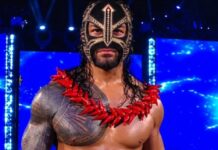
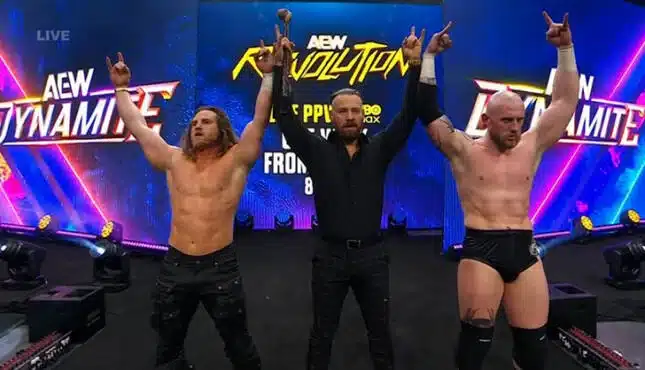
Just a week and a half before All Elite Wrestling’s next pay-per-view, Revolution, there was yet another debut for the promotion on this week’s episode of Dynamite. David Finlay, who recently announced his exit from New Japan Pro Wrestling, made a surprise appearance on TBS, and it was confirmed soon afterwards on social media that he was a part of the company, along with Clark Connors and Gabe Kidd.
The son of the legendary Fit, David Finlay broke into the business shortly before he joined New Japan as a young lion more than a decade ago when he was in his early-20s. The Japanese audience saw the third generation grappler grow up in the sport, as he worked his way up from the preliminary bouts to one of the featured stars on the roster as the leader of the final version of The Bullet Club faction. Finlay wasn’t a main event guy for the Japanese league, but he was a very solid performer that added depth to the roster, particularly when the line-up became rather thin with so many exits in recent years, as Tony Khan signed away almost every top star from New Japan in an effort to bolster his already bloated roster. Considering some of the other recent departures from the company, including Evil, Bushi, Hiromu Takahashi. the previously mentioned Clark Connors, and others, it’s possible that there would’ve been an opportunities for Finlay to move up the ranks.
Still, taking into account that he was there for over a decade, it also made sense for him to move on to a bigger stage for presumably bigger money.
I have to be honest, when I heard that Finlay was leaving New Japan a few weeks ago, I assumed that he would land in WWE, not only because of his dad’s role in their developmental system, but also because of the expanded opportunities in the organization, particularly under Triple H’s direction. In that regard, it’s uncharted territory, specifically with the purchase of AAA last year. Management knows that it’s an uphill climb in some respects to truly be able to incorporate a WWE-owned product into the fabric of lucha libre, especially with the longstanding traditions of the sport in the native country. Of course, it could be a tremendous business move if TKO is able to fully expand into Mexico because it would monetize one of the stronghold regions of pro wrestling in the world. Hispanic fans will go to the WWE event once or twice a year to see the spectacle of the global corporation, but lucha libre was built with weekly cards based on the live event experience. It’s not nearly as easy as slapping the WWE and AAA logos onto the same canvas for the Latino demographic to accept it as their brand of lucha libre. Because of that, and obviously the valuable revenue stream that is on the table, the WWE office knows that they need to recruit, develop, and promote talent in all facets to give the product the best chance to get off the ground on a long-term basis.
The reason that I mention this is that it adds a completely new aspect to the free agency market. A possible contract offer doesn’t have to be based on solely if a performer will excel on the main roster. They might be slotted to be an addition to AAA to add more depth to that project. If the money is right, and we know that TKO has the ability to offer basically any amount of money to prompt a talent to sign a deal, it would often be moot if the plans call for them to work in Mexico or the main roster. It goes without saying that being promoted by the WWE machine can make a career, and the ability to make the most money possible is the entire point of the business.
At the same time, it’s understandable that different wrestlers will have different goals at different points of their careers. At 32, David Finlay is in a position to try to make the most of his tenure in pro wrestling, as he’s in the prime of his career and has the experience under his belt to make the most of the opportunities that he’s given. The rumor mill suggests that Finlay was offered a WWE contract to compete on NXT, but he declined it because he didn’t want to work the developmental brand, which led to him taking the AEW deal. I can actually understand both sides of this, and it appears to be a case of two different concepts of what Finlay could be in the organization in 2026. In a sense, Finlay already logged his time in the developmental ranks when he worked his way up through New Japan for the past 10 years so to start on the WWE developmental brand might seem like running in place in terms of his individual career path. From the WWE side of things, they just called up a slew of talent to the main roster so they will have to replenish the NXT show. As I’ve written before, I get why NXT is dubbed the minor league project before a talent hits the main roster, but when it started on national television on the CW, it wasn’t truly a developmental brand anymore. When a novice’s mistakes can be exposed on national TV, it’s not a part of the developmental process, which is why Evolve was created with much less exposure. I bring up the status of NXT as essentially a third, albeit smaller brand of the WWE television line-up because with the platform that it has on the CW, the show still needs its seasoned workers to be the “glue” of the product.
The recruitment of Finlay might’ve been as simple as NXT needs a solid in-ring worker and then the office can see how he progresses with the WWE playbook. Clearly, Finlay had different aspirations for his career, and given his age, he probably should. One of the few criticisms that I’ve written about of the NXT brand for several years is that certain talent have spent several years of their prime on the smaller platform when they are more than talented enough to work on the main roster. The time that they have to wait for a spot on the main roster to open up is still time that they could theoretically be made into bigger stars if given the chance. We’ve seen some former AEW stars might the jump directly to the main roster so maybe Finlay would prefer a debut on Smackdown in a few years compared to working on the developmental brand for an undetermined amount of time since there are so many moving parts to the WWE machine.
It’s also well-known that Tony Khan offers hefty cash to those that he wants to add to the roster so maybe it was something as simple as Khan offered an amount of money that Finlay couldn’t say no to? Again, if that’s the case, you can’t blame him since making the most money possible is the name of the game.
That being said, as far as a career trajectory, I’m not sure that AEW will be that much different than NXT, at least in terms of exposure. Sure, the War Dogs faction got the artificial pop for their debut, but we’ve seen this type of scenario countless times before, someone will be featured on television for a few weeks before they end up lost in the shuffle like 85% of the roster. Where’s Juice Robinson? It’s well-known that Tony Khan is a fan of New Japan Pro Wrestling, but aside from the Continental Classic proving that he can’t just copy and paste a Japanese concept to American television, it was also proven that Tony can’t just book the New Japan roster to show up on TBS with the expectation that it will mean anything to the national audience. That’s not to take anything away from Finlay’s skills, but rather to point out that the lack of exposure is the key piece of the puzzle. Is David Finlay truly a big enough star that the national television audience will have any idea who he is? He’s a very talented performer, but we’re not talking about in-ring skills, this is as basic as will he be put in the best position to be successful when he’s booked to show up on Dynamite without any introduction?
As mentioned, Finlay probably did everything he could in New Japan unless they were going to move him up to the main event scene, and there wasn’t any indication of that so it made sense for him to go elsewhere. That being said, this formation of the War Dogs stable in AEW, implying that Gabe Kidd is now a part of the organization full-time is probably more of a hindrance to New Japan than anything else. Gabe Kidd looked to be one of the workers that the Japanese league was steadily moving up the ranks to replace some of the talent that left, which is why he competed against Kenny Omega in a stellar match a few years ago. The biggest takeaway from all of this might extend beyond an individual talent or a faction. Taking into account the overall lack of results in terms of moving the needle outside of Will Ospreay the argument could be made that Tony signing so many top stars from New Japan has negatively impacted the Japanese league exponentially more than it has benefited AEW.
What do you think? Share your thoughts, opinions, feedback, and anything else that was raised on Twitter @PWMania and Facebook.com/PWMania.
Until next week
-Jim LaMotta
Email [email protected] | You can follow me on Instagram, Facebook, & Threads @jimlamotta89