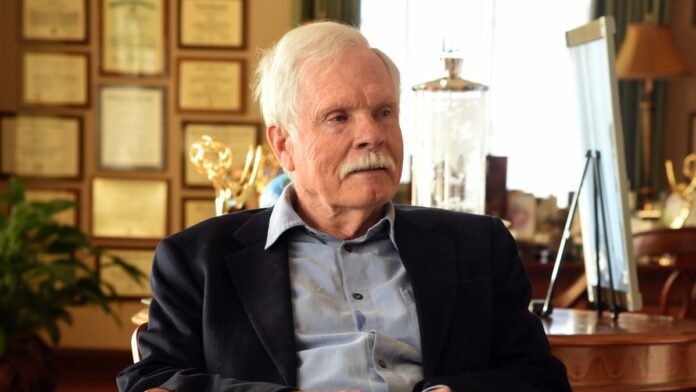
Ted Turner wasn’t a wrestling guy, but he was undoubtedly one of the most important figures in the history of the industry.
I was sad to hear that news that media mogul, Ted Turner passed away yesterday at the age of 87 after several years of a battle with a form of dementia. Of course, his most famous contributions were based on the distribution and expansion of cable television. The 24-hour news cycle was launched with the start of CNN in 1980. The domino effect of that can’t be understated, as not only did it create an industry that ranks among the highest-rated programs more than 45 years later, but the concept of cable news quite literally decided Presidential elections. Granted, there are substantive arguments to be made that the same concept eventual had a detrimental impact on society, which was more or less after Ted was retired, but the point is, Turner put the foundation in place decades ago for the notion that the public could get some form of instant information,
As far as professional wrestling, probably because Turner wasn’t vocal or in the public eye nearly as much as other promoters, I don’t think he truly gets the credit for the contributions that he made to the industry. Keep in mind, it was Turner’s TBS Super Station in the pioneering days of cable that gave sports entertainment its first national platform, albeit on a smaller scale because of limited distribution at the time. Georgia Championship Wrestling was one of the cornerstones of the success of the Turner network from the late-70s through the mid-80s when Vince McMahon’s purchase of the time slot on “Black Saturday” led to a brief run of WWF programming on the channel until the Jim Crockett line-up debuted on the station. When George Championship Wrestling’s time slot was bought by Vince McMahon in July 1984, the promotion shuttered, which left the Carolina-based Crockett group as the largest remaining piece of the National Wrestling Alliance.
Speaking of Crockett Promotions, when the group landed on TBS by the mid-80s, it was not only something that allowed the league to emerge as a competitor to Vince McMahon’s national expansion as other regional territories folded under the pressure, it also put the groundwork in place for the narrative of the business in the following decade.
As we know, Crockett Promotions spent itself into bankruptcy when it tried to keep pace with the WWF during that era. Remember, Jim Crockett Promotions was the remaining force of the National Wrestling Alliance, with its storied history, both before the launch of cable, and after as the new form of media expanded throughout the country.
Ted Turner knew the value that professional wrestling had to his networks so he bought Crockett Promotions in late-1988 to keep the sport on his channels.
This is one of the aspects where Turner doesn’t get nearly enough credit. If the NWA, which eventually morphed into World Championship Wrestling, had completely shut down in 1988, there wouldn’t have been a promotion on the air to spark the Monday Night war almost a decade later. We saw in the aftermath of the WCW buyout that the pro wrestling business was often stable and sometimes bland without true competition. That’s not a knock on the WWE either, but rather to point out what was probably an unavoidable pitfall without competition. Furthermore, we saw how rare it was to have someone like Ted Turner with the passion for pro wrestling and the resources to give it a chance to be a national commodity, considering that it took two decades for All Elite Wrestling to launch on the Turner networks.
When you take into account that massive success that Turner had in the media business, especially after cable became more or less a household item by the 90s, he definitely wasn’t a “money mark” as far as someone that was willing to throw money at a wrestling venture just to be a part of it. In fact, while it’s said that Ted Turner enjoyed the matches, he wasn’t someone that used the WCW platform to promote himself. You didn’t see Turner battling the NWO or standing in the middle of the ring to open Nitro.
Turner had a loyalty to pro wrestling because it had been good to him for years previously so when WCW couldn’t turn a profit for the first six years that he owned it, Ted took the write-off on his taxes and kept the doors open, which was a critical part of the industry.
The story of how Eric Bischoff took over as executive producer in 1994 and eventually got Turner to not only invest the money into the high-priced acquisitions of former WWF stars, but took steps to start the previously mentioned Monday night ratings battle is well-documented. However, let’s keep it in perspective, Turner was the one that signed off on Bischoff’s ambitious suggestion to go head-to-head with Raw each week. Without Turner being willing to give a pro wrestling show a prime time spot on his network, there might not have been the biggest boom period in the history of the industry.
We could parse detail on what went right or wrong with WCW in the late-90s. Macho was given a second run when Vince thought Savage was too far past his prime, Hogan reignited his entire career for a major heel run, the NWO ultimately pushed the WWF to embrace the attitude era, and American audiences were exposed to more international talent than ever before with a mixture of lucha, as well as Japanese talent, on Nitro. The company was mismanaged, dozens of wrestlers were paid to do nothing, and the booking eventually got so horrendous that the product fell off a cliff.
Regardless of the positives or the negatives of World Championship Wrestling, the biggest takeaway from the entire narrative of the organization under Turner ownership was that the media barron was the only one to ever put Vince McMahon on the ropes. Ted Turner was the only guy to ever get the better of Vince McMahon on a truly measurable scale in the history of pro wrestling. In 1994, Uncle Sam couldn’t put Vince in as much jeopardy as the Turner networks did by 1997. For years, the WWF didn’t acknowledge anything outside the realm of its own organization, but when Nitro took a noticeable portion of the audience on Monday nights, the infamous “billionaire Ted” skits aired in 1996 to mock Turner, Savage, Hogan, and Gene Okerlund. Vince McMahon didn’t sell for the federal government, but he reacted to Ted Turner. Obviously, the skits were designed to downplay WCW as the retirement home for older WWF stars, but the recognition alone told the audience that there was another player in the game. That notion was reinforced when Scott Hall and Kevin Nash made the jump to WCW just a few months later. As we know, when AOL merged with Time Warner in January of 2000, the domino effect led to the consolidation of the amount of authority Ted had over the Turner side of the assets. When WCW lost $60 million that year, it was easy for the executives to decide to cut their losses and sell to Vince McMahon for pennies on the dollar. Make no mistake about it, Ted Turner had a track record of staying behind wrestling, even through the financial slumps so if he had the power to keep WCW in the portfolio, he would’ve kept it open in 2001. That’s why there’s speculation about the status of AEW’s television deal in the future with the upcoming Paramount/Warner Brothers Discovery merger.
All Elite Wrestling did a very nice tribute to Turner on Dynamite last night with Tony Schiavone and Sting to open the show. There are a lot of criticisms about All Elite, many of them valid, and as mentioned, there’s speculation about the future of its TV contract, but it was certainly fitting that the first truly competitive option since the closure of WCW twenty years earlier found a home on the Turner networks. Outside of the business world, Turner donated to many charitable causes and looked to donate most of his fortune upon his death. As I said, Ted Turner wasn’t a wrestling guy, he didn’t book angles, run a territory, or take bumps in the ring, but his impact and the domino effect that it had shaped the direction of the entire industry.
What do you think? Share your thoughts, opinions, feedback, and anything else that was raised on Twitter @PWMania and Facebook.com/PWMania.
Until next week
-Jim LaMotta
Email [email protected] | You can follow me on Instagram, Facebook, & Threads @jimlamotta89