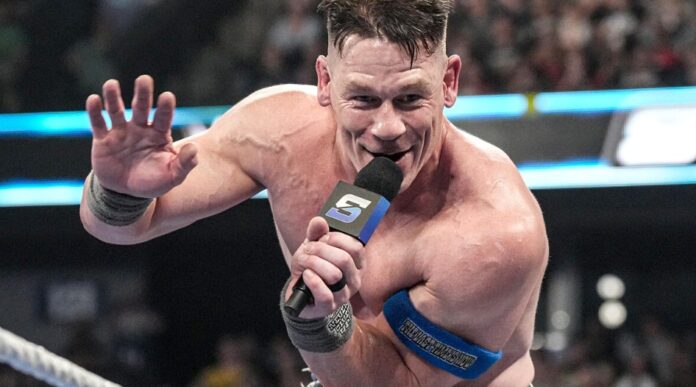
John Cena has reflected on his controversial heel turn during his final year in WWE, admitting that he accepts the criticism that it failed creatively while remaining glad that he took the risk.
Speaking with Graham GSM Matthews on WrestleRant, Cena argued that whether the storyline worked depends on how its success is measured. From a business perspective, he pointed to WWE’s attendance and viewership during the run, while acknowledging that the creative reception was considerably more divided. “As far as ‘Did it work?’ There are a lot of aspects to that. From a business side, we didn’t have a seat left. People watched in numbers. I don’t know if it didn’t work from a business standpoint, but then there’s a creative standpoint,” Cena said. “Sometimes, blockbuster movies are poorly reviewed by critics. I understand where, critically, people are like, ‘This isn’t what I wanted.’”
Cena revealed that his preferred version of the heel character would have gone considerably further. Ideally, he wanted to become so deliberately unpleasant to watch that audiences would desperately want a hero to remove him from the top spot.
However, Cena acknowledged that such an approach wasn’t realistic given the limited time remaining in his career and the potential consequences for WWE’s business. “Intrinsically, I would’ve loved to have a chance to literally ruin wrestling. To wrestle so poorly that people just wanted to see me go and wanted to see a hero thwart me,” he said. “We didn’t have that kind of time, and that would not have been good for business. That would’ve made people stop coming to shows and the numbers go down.”
Cena also believes actually attempting the heel turn was preferable to leaving fans forever wondering what might have happened had WWE finally pulled the trigger.
The idea itself didn’t originate with Cena. He revealed that WWE Chief Content Officer Paul “Triple H” Levesque proposed the turn and that he agreed almost immediately. “It wasn’t my idea. It was Paul’s idea. He asked me, and two seconds later, I said yes. Just like facing Brock or tapping out to Gunther. ‘Yes.’ That’s how I do business,” Cena said. “Yes, just let me tell the story my way. If we never did it, I would’ve been fine. In reflecting, I wouldn’t change a thing.”
Levesque previously offered a similar account, explaining before WrestleMania 41 that WWE could have spent Cena’s farewell year celebrating his greatest hits but instead explored the possibility of finally making the creative move the company had resisted for years.
For Cena, the experience now gives him a real example to point toward when encouraging younger wrestlers to take creative risks. “I’m glad we got to do it because it helps me now when I speak to younger talent and say, ‘Be bold. Take chances. Don’t worry about failing,’” he said. “I come from a place of activity, not a place of privilege where I’m in some sort of protective bubble.”
Cena isn’t interested in arguing with fans who believe the storyline ultimately failed. “A lot of folks will say, ‘The heel turn failed.’ Okay, I accept that as a failure, but I swung boldly,” Cena said. “A lot of folks were upset with the finish of the last match. I accept that critique, and I feel great that I swung boldly in my final moment.”
Cena’s long-awaited heel turn took place at Elimination Chamber on March 1, 2025 in Toronto. After winning the Men’s Elimination Chamber match, Cena aligned himself with The Rock and Travis Scott before attacking Cody Rhodes.
Cena subsequently defeated Rhodes at WrestleMania 41 to capture the Undisputed WWE Championship and become a record 17-time world champion.
However, the storyline involving The Rock and Scott never received its originally envisioned payoff. Scott made one further appearance, interfering at WrestleMania 41 to help Cena defeat Rhodes, while The Rock didn’t return to WWE television during Cena’s heel run.
Paul Heyman later confirmed on The Ariel Helwani Show that there had been plans for a payoff involving both men, but those plans fell apart and WWE moved forward without them.
Cena ultimately returned to being a babyface on the August 1 episode of SmackDown, five months after his heel turn.
His retirement match took place on December 13, 2025 at Saturday Night’s Main Event, where he submitted to Gunther.
Looking back, Cena is willing to accept that the heel experiment didn’t satisfy everyone creatively. What he doesn’t regret is finally answering one of the biggest “what if?” questions of his WWE career by taking the chance in the first place.