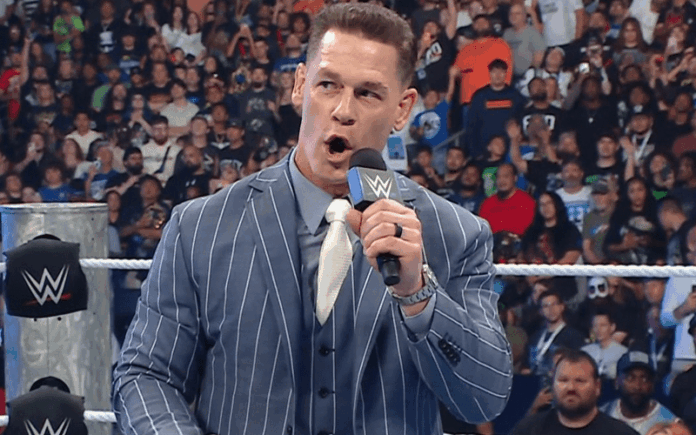
John Cena has reflected on the evolution of professional wrestling, explaining why the industry’s decision to openly acknowledge its entertainment-driven nature was a crucial turning point.
During an interview with Trevor Noah, Cena discussed the challenges wrestlers faced when promotions attempted to present their matches and characters as entirely legitimate, particularly during an era when performers were expected to maintain their personas outside the ring.
Cena pointed to the demanding travel schedules that became commonplace during WWE’s national expansion under Vince McMahon in the 1980s, noting that wrestlers often spent more time portraying their characters than living their personal lives.
“I think as performers, in a day and age where they sold it as a shoot or as real, these are real fights, the personalities had less time away from the personality. And keep in mind, in the globalization of wrestling, when Vince McMahon took over in the early ’80s, the schedule was arduous. I’m talking like 30 days on, seven days off, 30 days on, seven days off or less. And you’re doing your own promotion, so you spend more time as the IP than you do as a human.
So when it’s supposed to be real, you got these guys who are trying to convince fans to come in the building and see them, and they assume the role, and it’s really tough to shut the switch off.
It was a steep hill to climb for wrestling, but one of the best things they did is admit that it was entertainment. It is not pure sport, because it was dishonest. Now we’re honest. So that was the mid-’90s. Tough hill to climb. You got to recorrect. You got to rebrand.
But the audience has always been rabid, whether they thought it was real or they know that they’re coming to a show. Wrestling has always been filmed, shot, consumed as the audience is just as important as the performer, whether you know it or not.
When you look at what we do, tons of crowd shots, crowds chanting. They’re literally like European football crowds.
But we don’t want them to shut up. We want them to keep being as rowdy as they can, because if we perform to apathetic silence, it’s really just kind of two guys in their underwear doing stunts.
We got over, and I was happy to be involved in a lot of that rebranding process. Also, the product goes through phases. You cater to your audience. In the ’80s, Hulk Hogan was nationalist virtue, you know, ‘Say your prayers, eat your vitamins,’ you know, do good. And then Stone Cold Steve Austin, the Attitude Era, was drink beer, flip off your boss. And then more families started to show up around the time that I started.”
Cena emphasized that audience participation has always been central to professional wrestling, regardless of whether fans believed the action was legitimate competition or understood it as a scripted performance.
He compared the atmosphere at wrestling events to European football matches, highlighting how chants, crowd reactions and emotional investment contribute to the overall presentation.
The former WWE Champion also discussed how wrestling has continuously adapted to changing audiences, referencing the patriotic, family-friendly presentation of Hulk Hogan in the 1980s, the rebellious attitude of Stone Cold Steve Austin during the Attitude Era, and the renewed emphasis on family audiences during his own rise to prominence.
For Cena, acknowledging wrestling as entertainment did not diminish its appeal. Instead, he believes the shift allowed the industry to become more transparent while preserving the passionate audience interaction that makes professional wrestling unique.