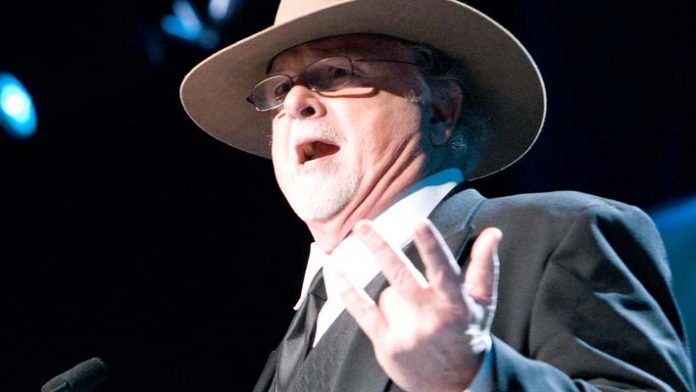
Yesterday, a titan of the professional wrestling industry, “Cowboy” Bill Watts passed away at the age of 87. Known as the hard-nosed promoter of the Mid-South Wrestling territory, the successor to the NWA Tri-State region under the leadership of Leroy McGuirk before that, Watts was one of the last remaining links to a bygone era. Unfortunately, despite remaining active in the business for more than 30 years and having an influence that can still be seen today, Watts, partially because of his own decisions, is often forgotten about today. In more modern times when nostalgia is celebrated, Watts isn’t usually mentioned in the conversation of classic pro wrestling, but make no mistake about it, “Cowboy” Bill Watts was one of the most important figures in the history of the sport.
Breaking into the business as a wrestler in the early-1960s, Watts was a big name that worked with top stars throughout the territory system. He was a charismatic talker with a John Wayne-type persona that brought fans to the box office. Watts knew how to draw money, both as a performer and as a promoter, which is the entire point of the industry. That being said, Watts wasn’t know for his stellar in-ring work, and in truth, that’s not how he made a career anyway. He wasn’t Ricky Steamboat or Ric Flair, but he did enough to sell tickets in his heyday.
His limited in-ring skills were probably why he made an effective transition to the role of a promoter by 1980. Watts knew enough to know that as he got older, he didn’t have the technical skills to realistically extend his in-ring career so a move to the office, where he could use his brilliant mind as a booker, was key to a domino effect that had a major impact on the direction of the business. The Cowboy knew that personal issues and heat draw money, which is still the case today.
As much as Watts falling behind the times is why he isn’t as remembered today, there’s no doubt that he was ahead of the curve in some ways throughout his tenure as a promoter. With the Mid-South territory spanning the several states that it did, and a notoriously grueling tour schedule that went along with it, Watts knew that to build to the big cards in the bigger cities, he would need a compelling television product to entice those from the smaller towns to make those trips to the major arenas for the signature events. Watts could give away more on television than other areas in the country because of the geographical size that Mid-South covered. Keeping the fans across the entire territory informed and enthusiastic about the talent kept them following the product, even if a live event wasn’t scheduled for their town that week.
With that in mind, the roster that Mid-South had throughout the majority of the 80s was a truly all-star line-up and paved the way for many of those names to eventually find national fame later in their careers. The legendary Junkyard Dog was promoted and developed in Mid-South. Jim Cornette and The Midnight Express had a major run there that set them up to become national names in Jim Crockett Promotions. Ted DiBiase, Kamala, Jim Duggan, and a myriad of other names raised their stock in the business under the direction of Bill Watts. Jim Ross got his first major break working for Watts, opening the door for him to transition to WCW when The Cowboy eventually sold to Crockett promotions near the end of the decade.
The television program and the way that it showcased those previously mentioned stars is probably the biggest legacy of the territory. Watts had the foresight to realize that typical squash matches with the guy that changed your oil weren’t enough to truly build the product. The WWF got away with that formula for years because Vince McMahon sold the sizzle of sports entertainment and that worked for his markets. Watts had competitive TV matches, wild angles, and even the preliminary talent were athletes. He even took a camera to the arenas to use footage from the house shows on television, which enhanced the overall presentation of the roster.
Again, as much as Watts being from the stone age more or less saw him without a place in the business as time went on, as mentioned, he didn’t totally lack the vision for where the business was going. Mid-South had strong years in 1982, with JYD as a top drawing card, and 1984 when The Midnight Express vs. Rock N’ Roll Express was a top feud. Of course, Watts’ original comeback as apart of “The Last Stampede” with Stagger Lee as his tag partner against the previously mentioned Midnight Express in 1984 drew big houses. The point is, when things plateaued at different times, Watts shuffled the deck. In 1983, when the promotion was somewhat stagnant with an oversaturation of heavyweights, the fast-paced tag teams were brought in. When JYD left in 1984 to go to the WWF, there was no doubt that it was a major dent in the drawing power of Mid-South. Guys like Duggan and DiBiase, along with a young Terry Taylor, and Magnum TA before he went to Crockett Promotions kept the organization stable.
However, when there was no denying the stranglehold that Vince McMahon’s Rock N’ Wrestling with MTV had on the general public after the success of Wrestlemania, Watts understood that the industry was quickly drifting away from the territory system that had been the foundation of the business for decades. He changed the name of his group to the Universal Wrestling Federation in 1986 to avoid being typecast as minor league compared to the expanding WWF. Big Bubba Rogers before he was Big Bossman had a solid run in the UWF. One Man Gang, Terry Gory, and Steve Williams also had notable runs there. That being said, and history proved this to be true, nobody had the resources or the business plan to truly compete with McMahon. The oil bust of the mid-80s, which saw the price of a barrel of crude oil fall by almost 70% had a major impact on the economy within the states of the territory. Much of industry of Louisiana, Oklahoma, and Arkansas sharply declined in a relatively short period of time. The TV ratings remained strong, but attendance across the board was sluggish, causing Watts to hemorrhage cash on a weekly basis. Fans still wanted to watch wrestling, they just couldn’t afford to go to the arenas to see it in person. It makes you wonder what could’ve happened with the UWF on a long-term basis if the oil industry didn’t tank in 1986?
When Watts saw the writing on the wall, he was smart enough to cash out on his wrestling project to avoid the bankruptcy that many stubborn promoters endured in that era. Ironically, Jim Crockett’s agreement to buy the UWF, including its television time, for a reported $4 million in 1987 was one of the many reasons that JCP eventually went out of business just over a year later, forcing the to sell to Ted Turner.
For all intents and purposes, the 1987 sale to Crockett was more or less the end of Watts’ career in the industry. He spent more than three decades in the industry and made millions in the process so he had enough financial security to choose to step away rather than look for work in a rapidly shrinking business. When a revolving door of figureheads couldn’t run World Championship Wrestling in the eatly-1990s after the Turner purchase, Watts was brought in as the booker in 1992. He hadn’t followed the business in the five years since he sold his company and was so far behind the evolution of the sport that his tenure as a boss lasted less than a year. He had a cup of coffee in the WWF for a few months in 1995 when business was down, but again, he clearly had no idea where the business had evolved toward since he sold UWF years earlier.
Over the years, specifically when shoot interviews were popularized in the early-2000s, there was a narrative that Bill Watts was a bully and possibly a racist. There’s no doubt that Bill Watts sounded like an absolute jerk at various points of his career. However, in all fairness, he doesn’t deserve to be labeled a racist. Granted, it wouldn’t be shocking if an old white guy from the south had ignorant views, but a look at Watts’ track record doesn’t put him in that category. Watts trusted Ernie Ladd as his booker for years in Mid-South, Watts promoted Junkyard Dog as his top star, and he was the one that decided to book Ron Simmons as the first black heavyweight champion of a national promotion when he worked for WCW in 1992. Furthermore, during an RF Video shoot interview in 2000, Watts had tears in his eyes when he talked about he death of JYD, regretting that he didn’t have the chance to tell him how much he meant to him before his tragic passing in 1998 as a result of a car wreck.
You’ve heard numerous stories of how Watts was too obtuse to work for a corporation so it’s doubtful that he would manufacture empathy for the death of a black star years after he was done with the business. Was Bill Watts a jerk? It definitely sounds that way, but calling him a racist, at least from what’s publicly known, might be misguided.
In 2009, Watts was inducted into the WWE Hall of Fame, which was basically a way for him to get another payoff, as his induction included the sale of the Mid-South tape library, and it was a way for the WWE to get the territory footage for what would become the WWE Network. As I said, Watts had been out of the spotlight for years, his HOF indication was brief and he had very little to do with the industry over the past three decades. So while he isn’t as discussed or as remembered today, there’s no doubt that he was one of the most important and influential figures in the history of the business.
Until next week
-Jim LaMotta
E mail [email protected] | You can follow me on Instagram, Facebook, & Threads @jimlamotta89