Is Ricochet right or delusional?
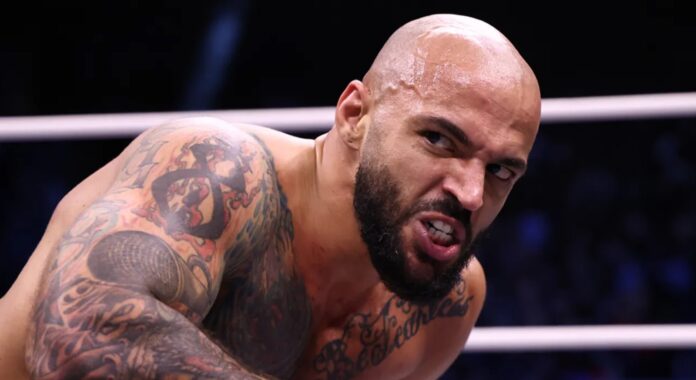
Ricochet, the grappler who broke into the business on the dirt-stained canvases of the independent circuit in the early-2000s during his teenage years, made headlines last week when he claimed that the WWE “tarnished his legacy” during an interview on the Mark Hoke show to promote AEW’s event in Las Vegas.
Ricochet spent just over five years under the WWE umbrella, inking a contract with the company in early-2018 before he eventually left the organization after being written off television in mid-2024. The aerial star won the United States and Intercontinental titles during his time on the main roster, but never seemed to progress beyond the middle of the card. The year he spent in NXT prior to when he was called up to Raw saw him have a stint as the North American champion at a time when there was still a noticeable buzz around the brand in 2019.
In truth, it seemed like the office didn’t know exactly what to do with Ricochet beyond putting him on the shows to work the dazzling style that gained him notoriety prior to his arrival in the company. At one point, there was an ill-fated attempt to put him in a full body suit to try to make him look like a superhero, which was thankfully phased out rather quickly.
Still, Ricochet was in the mix, being paired with Logan Paul for a featured match at Summer Slam in 2023. That would suggest that the promotion had a level of trust with his skills, as Logan Paul is still relatively inexperienced now, but was even more of a novice a few years ago so it wasn’t a coincidence that the office put him in the ring with Ricochet to make sure everything went smoothly.
That’s a testament to the reputation that he established during the prior decade that earned him a WWE deal in the first place. There’s no doubt that Ricochet is an incredible athlete and one of the best high-flyers of his generation. His athletic skills aren’t up for debate.
That being said, the notion that the WWE “tarnished his legacy” is laughable. In the grand scheme of things, Ricochet had notoriety, not a legacy, before he debuted in the company. He’s more or less in the same place today, not because he doesn’t have the talent to have a legacy by the time he hangs up his boots, but rather there are still chapters to be written from a performer still in the prime of his career.
Between the interview appearance and nonsense posted on social media, Ricochet’s main point of contention seems to be that his “work rate” style is more important than the sports entertainment presentation of the WWE. He went as far as to bring other names up to try to bolster his case, claiming that El Generico had a “better legacy” than Sami Zayn, a way to imply that Sami’s independent work was better than his WWE career. He also cited Finn Balor, Shinsuke Nakamura, and Apollo Crews.
Basically, this would be the sophisticated debate of art vs. commercialism, but Ricochet is too obtuse to have that discussion. He boiled it down to WWE is automatically hindering the sport because its presentation is tailored to the general public rather than the pro wrestling purest, which is such a narrow-minded view point of the industry.
Taking nothing away from Ricochet as an athlete, there’s a reason that he worked for Dragon Gate, New Japan, and received rave reviews in PWG. However, if he believes that a dazzling spot fest in front of 400 fans is more important than a worldwide platform with an income well into the six-figure range than that might be one of the reasons that the office didn’t invest main event stock into him during his tenure with the company.
Let’s be honest here, while Ricochet certainly has a right to his own career aspirations, he sounds like a total doofus when he makes the same statement about others’ careers. Sami Zayn is one of the most over and most versatile performers in the entire industry. He’s an underdog that the audience connects with and that can draw money, which is the entire point of the business. Sami is a much more well-rounded performer now than he was during his time under the El Generico gimmick because the audience knows more about the real-life performer so it’s much more identifiable with the fans than a gimmick that was meant as an inside joke for the smart mark demographic.
The real-life performer made more money as Sami Zayn, has competed in front of exponentially bigger crowds, and is a much more well-rounded performer than the El Generico character. If Ricochet can’t understand the difference between a sold out arena in Montreal rallying for Sami to win the championship as opposed to El Generico at the VFW in Reseda than again, it’s more proof that he doesn’t understand the multi-layered approach to the WWE business model, as well as how many boxes they need to check for their main event stars. Sure, Finn should’ve had a bigger run, Nakamura should’ve been the first recognized Japanese WWE champion, and maybe Apollo should’ve been given more opportunities, but that’s not a modern critique for the WWE or any other organization. Mr. Kennedy probably shouldn’t have been canned in 2007, Rey Mysterio shouldn’t have been booked to lose his mask in 1999, and Jim Crockett shouldn’t have bought Bill Watts’ territory for $9 million in 1987 when Watts would’ve had to eventually fold anyway.
The difference between those situations and the examples that Ricochet tried to cite is that Finn, Nakamura, and Crews all obtained financial security working for the WWE. It might be a harsh reality check for some, but seven figures is always going to be more important than seven stars. How many dives did Steve Austin do when he became the biggest star in the history of the business?
Thankfully for Ricochet (and several others), a billionaire that is a huge wrestling fan decided to launch a company. We’ve seen before that Tony Khan is a great guy, but the scope of AEW is essentially a vanity project because his family has enough money to fund the venture as long as he wants to continue to be a promoter. His qualification to be the promoter of the second-largest pro wrestling group in the United States is that his family has the money to fund it. All Elite Wrestling doesn’t have to be self-sustaining so money in no object. That allows someone like Ricochet to show up, do every high spot in the book without being able to truly move the needle, and he can make at least comparable money to the WWE contracts. That’s not a knock either, if Tony Khan is willing to offer Ricochet that type of cash then good for him, that’s capitalism.
However, the unique circumstances of AEW being a pro wrestling company that doesn’t have to focus on the profit margin doesn’t change the fact that Ricochet doesn’t understand the most basic premise of the pro wrestling industry, which is to draw as much money as possible. How many memorable Ricochet promos have you seen? Can he really be successful with a 15-minute mic segment on Raw to sell the next pay-per-view? If the high spot style was enough of a draw to be successful at the biggest stages, TNA would’ve been a lot bigger during its heyday, and AEW would be more successful than it is today.
Ironically, Ricochet’s mindset that the WWE “tarnished his legacy” is probably why he doesn’t actually have an established legacy yet.
What do you think? Share your thoughts, opinions, feedback, and anything else that was raised on Twitter @PWMania and Facebook.com/PWMania.
Until next week
-Jim LaMotta
Email [email protected] | You can follow me on Instagram, Facebook, & Threads @jimlamotta89