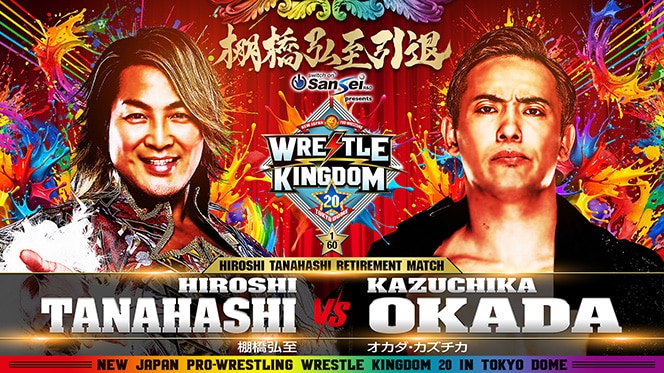
When it comes to the biggest event on the Japanese pro wrestling calendar, for the past two decades, it has been Wrestle Kingdom, New Japan’s version of Wrestlemania that brings their signature card to the historic venue that has hosted some of the biggest matches, fights, and entertainment ventures in the history of Japan since it opened more than 35 years ago. It was the place where Buster Douglas shocked the world when he KO’ed Mike Tyson in his prime for a bout that had him as a 42-1 underdog. It was the building where Pride Fighting Championship debuted in 1997, kicking off a decade of MMA that shaped the direction of the sport around the world. The venue hosts a slew of baseball teams as well. It was where the legendary Jushin “Thunder” Liger retired six years ago, and it just hosted the stage for another iconic New Japan star to hang up his boots at this year’s Tokyo Dome event.
Hiroshi Tanahashi, who announced last year that he was set to retire at Wrestle Kingdom in 2026, had his final bout of a legendary career that spanned more than a quarter century against an apropos opponent, Kazuchika Okada. To encapsulate the entire career of “The Ace” of New Japan in one article, DVD set, or book would be difficult, as the conclusion of his career strikes a cord that will echo throughout the Japanese pro wrestling scene on many different levels.
For somewhat of an apples to apples comparison since we just saw the retirement of John Cena a few weeks ago, you could say that Tanahashi was the Cena for New Japan. He was a truly beloved star that would take time to interact with the fans and took his responsibilities as the top guy seriously. Through even the rough patches of NJPW, including the change in ownership a few times and a downturn in business, Tanahashi was one of the tent poles that kept the Japanese league afloat. As we’ve discussed with Cena, he was a representative of the brand, you never saw him get a DUI or bring negative press on the company through anything scandalous, which is a small miracle in the social media age. In recognition of that, Tanahashi was named president of the organization a few years ago.
In some ways, Tanahashi is one of the last links, in terms of top stars, of the last generation of wrestlers that were under the direction of the late New Japan founder, Antonio Inoki, who sold a controlling interest to the THQ video game company in 2005 before he left the organization completely. As we know, before THQ went bankrupt, they sold the promotion to Bushiroad, which rescued the wrestling league, allowing it to have a surge in popularity that lasted roughly six or seven years.
To truly understand the importance of Tanahashi, it’s key to put the time period of his original run in NJPW in context. After the previously mentioned Pride Fighting Championship surged in popularity in the early-2000s, Inoki tried to pattern his pro wrestling group after it, leading to disastrous results. Some might try to look back on “Inokism” with rose-colored glasses, but make no mistake about it, the failed MMA experiment took New Japan to the brink of collapse. Tanahashi carried the company on his back through some very lean years and a significant degree of uncertainty during that era. After Bushiroad bought the company in 2012 and there was an influx of cash to be able to bring in more foreign talent, and the expansion of merchandise to generate more revenue, it was Tanahashi that passed the torch to Okada through their fantastic series of matches in the mid-2010s to propel a new star. Make no mistake about it, Okada wouldn’t be where he is today without the initial rivalry that he had with Tanahashi.
That’s why it was so fitting that Okada returned to New Japan for this retirement bout. There’s no doubt that Tanahashi is a top-notch performer that checks all of the boxes of a main event wrestler. Everything he did was crisp and smooth. You simply aren’t going to find a subpar Hiroshi Tanahashi match, specifically in the prime of his career. He was consistent quality in the ring throughout his legendary career, hence why he was trusted with the top spot for as long as he was. That being said, father time is undefeated and similar to so many that worked the Japanese style for years, the physical toll of his efforts in the ring has very clearly had its effect on him. Tanahashi has notoriously bad knees and hasn’t moved well in the ring the past few years. However, it’s a testament to his experience and ring smarts that he has been able to mostly work around his limited mobility more recently.
Proof of Tanahashi’s massive impact on Japan is that for the first time in several years, Wrestle Kingdom was sold out, with more than 50,000 tickets sold about a week before the show was set to take place. During his heyday, Tanahashi was the in-ring worker, whereas Cena was entertainment based, which is fine, considering that they both drew money as the top star in their respective organizations. The common theme was that their retirement matches drew big numbers because the fans wanted to see their final bouts, the in-ring action or the result was secondary.
That being said, the success of this year’s Tokyo Dome event was based on the Tanahashi retirement, which made business sense, but the narrative of the promotion itself is very much influx. There are peaks and valleys with everything, even the Attitude era came to an end. As mentioned, New Japan had several lucrative years after the group was purchased by Bushiroad, as the combination of foreign talent in The Bullet Club and native stars brought a surge of popularity for the promotion. The launch of AEW took a core group of talent away from the Japanese league and in the years since then Tony Khan has signed away almost every top NJPW star. That’s not a criticism, that’s capitalism, as New Japan simply can’t compete with the amount of money a billionaire can offer talent on the roster. Still, it’s a really difficult task for the New Japan office to attempt to replenish that amount of talent in a relatively short time.
Obviously, it’s not a matter of just pushing talent up the card to fill the void when other main eventers left, as it depends on if that guy is in the right spot at the right time for the push to be successful. The pandemic didn’t help matters, as the majority of the New Japan business model depends on live event tickets so it was a massive hit to their bottom line when events were canceled or held with very limited capacity for a few years. The argument could be made that the company still hasn’t truly recovered from the impact of the pandemic. Don’t get me wrong, the organization is stable because Bushiroad is behind it, but there was undeniably a downturn in business the past few years.
In theory, the audience for Tanahashi’s retirement, including its broadcast on television, could provide a platform for the younger talent of New Japan to showcase themselves, but it remains to be seen how effective it was in the grand scheme of things. Shota Umino challenged Zack Sabre Jr. for the IWPG heavyweight championship last year, but didn’t win it and his main event push was rather undistinguished. Yota Tsuji beat Konosuke Takeshita for the title, and seems to have a more realistic chance to take the top spot than Umino did, but with so many variables, it remains to be seen if Tsuji can be a legitimate draw on a consistent basis. Aaron Wolf, an Olympic gold medalist in Judo, made his debut for the organization, but despite the publicity and a decent under card, it’s very clear that Wrestle Kingdom was a one-match show, the crowd was there to see Tanahashi’s last match. The match itself was solid with a level of drama that built toward the finish. Given Okada’s history with New Japan, I don’t think it was a letdown that he beat Tanahashi, especially since the draw was the spectacle of the conclusion of the legendary career, not the result of the contest. The post-match ceremony with several former NJPW wrestlers and legends to watch Tanahashi’s retirement bout was a very nice moment.
That’s why you can’t discount a sell out of the Tokyo Dome, moving 50,000 tickets for a show is undoubtedly a major success, but it’s important to keep in mind that with the draw being based on the conclusion of a legendary career, there’s still an amount of uncertainty around the future of the organization, as far as how much of an impact it will have on the entire industry.
What do you think? Share your thoughts, opinions, feedback, and anything else that was raised on Twitter @PWMania and Facebook.com/PWMania.
Until next week
-Jim LaMotta
Email [email protected] | You can follow me on Instagram, Facebook, & Threads @jimlamotta89