Eric Bischoff says he is happy with his life outside of professional wrestling and cannot envision any circumstances that would convince him to return to the business.
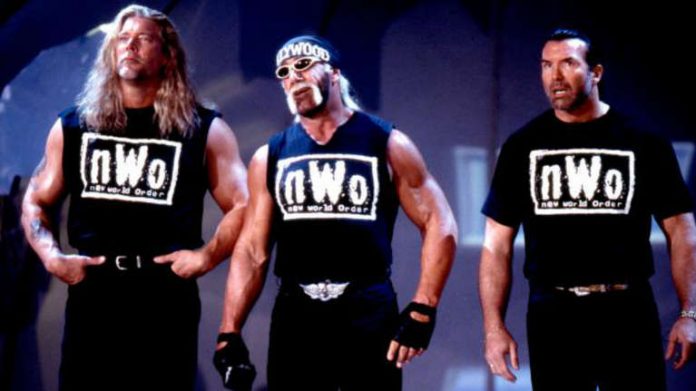
Speaking on the latest episode of 83 Weeks, Bischoff discussed his future as the conversation turned to the 30th anniversary of the nWo and the continued popularity of merchandise associated with the legendary WCW faction. “Look, I’m very happy with my life away from sports entertainment. I could not foresee any scenario that would bring me back into it. Not because I don’t love it, appreciate it, respect it for what it’s provided to me and my family, but because there’s a certain point where you just have to move on and embrace new challenges.”
Bischoff said he no longer feels any need to seek recognition for what he accomplished during his wrestling career. “So I don’t think about sports entertainment in the sense of really what I’ve even accomplished in the past and fighting for respect or anything like that or acknowledgement. My ego isn’t tied to it at all, not even a little bit. I recognize certain things that I think are important, and I’m proud of.”
One of those accomplishments is the nWo, which celebrates its 30th anniversary this year.
Bischoff believes the group meant different things to its principal members, and said Hulk Hogan’s connection to the nWo was particularly significant because of how much of his life had been devoted to his wrestling persona. “I know if Hulk was here, it would mean so much to him because the character, and the value that he could bring to that character, that’s who he was, that’s what drove him. That’s what got him out of bed every morning.”
Hogan famously turned heel at Bash at the Beach in July 1996, joining Scott Hall and Kevin Nash as the nWo’s mystery third man after spending more than a decade as wrestling’s most recognizable babyface.
Bischoff believes that decision made Hogan’s connection with the faction especially meaningful. “He was so committed to that character, and then to make the change, and take the leap, and go to the dark side. That made his appreciation for the nWo even more significant than it probably did for Kevin or Scott.”
Hall and Nash’s experience was different. Both had left WWE for WCW and immediately became central figures in the company’s biggest storyline. “For them it was different reasons because they left kind of underappreciated WWE and they came and just made the statement they wanted to make immediately after showing up. There was no 12-month story arc that got them there. They walked in, took s*** over, and made history within 30 days.”
Bischoff also included Sean Waltman, who joined WCW later in 1996 and became Syxx, among those whose careers were transformed by the faction.
While wrestling promotions have repeatedly attempted to create dominant factions in the decades since, Bischoff does not believe the nWo’s impact can ever truly be replicated. “Nobody’s ever going to achieve what the nWo achieved. Nobody. I don’t care who you are, how good you are. You’ll never come close to doing what we did with the nWo in the television wrestling business. Because those conditions no longer exist.”
Bischoff believes the circumstances surrounding the Monday Night Wars were as important as the people involved. WCW and WWE were competing directly against one another on Monday nights, while Turner Broadcasting’s ownership gave WCW the resources to aggressively compete for talent and viewers.
The resulting run saw WCW Monday Nitro defeat WWE Raw in the television ratings for 83 consecutive weeks, which later provided the name for Bischoff’s podcast.
Rather than taking sole credit for what happened, Bischoff described the nWo as the product of numerous circumstances aligning at exactly the right moment. “For me to know that there’s product out there that will, the result of an idea, it was a moment in time where all the other critical moments had lined up in a perfect genetic sequence to allow magic to happen. That I’m not so much proud of it because a lot of it was out of my control, those moments, but I’m so grateful to have been a part of it because it was magic.”
Bischoff’s last full-time position with a major wrestling promotion came in 2019, when he briefly served as WWE’s Executive Director of SmackDown. He was inducted into the WWE Hall of Fame in 2021 and has remained involved with wrestling through podcasts, appearances and conventions without taking another permanent role.
He continues to comment regularly on the modern product, including recently agreeing with Conrad Thompson’s criticism of Roman Reigns as an overrated WWE main eventer.
But when it comes to actually returning to work inside the wrestling business, Bischoff appears to consider that chapter of his life finished.