Eric Bischoff is pushing back against renewed criticism surrounding his time in TNA Wrestling, making it clear he has no interest in revisiting what he calls “revisionist history.”
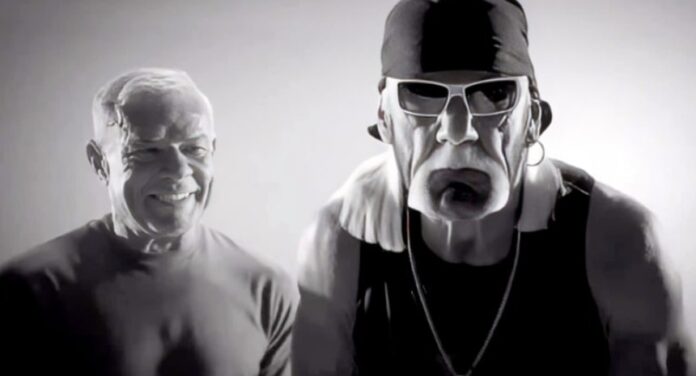
With Vice TV’s three-part Dark Side of the Ring series on TNA and Vince Russo’s newly released book, Total Nonstop Agony, bringing fresh attention to the Hogan-Bischoff era, the WWE Hall of Famer addressed the conversation on 83 Weeks.
Bischoff revealed he has neither watched the documentary nor read Russo’s book. “I’ve noticed some, but I honestly just don’t have the bandwidth for it, so I haven’t read much of it,” Bischoff said regarding the online discussion surrounding the documentary. “I don’t know what revisionist story people are out there peddling right now, but have at it, have fun with it. If it makes you feel better about yourself, whether you’re a social media wrestling expert or whatever, have fun. Go ahead.”
He offered a similar response when asked about Russo’s book, which includes criticism of both Bischoff and the late Hulk Hogan. “No, I haven’t seen it. I knew he was writing a book, or a book came out, but that’s all I know,” Bischoff said.
One point Bischoff was eager to clarify was his actual role within TNA, insisting he had no authority over the company’s business operations. “Let me make one thing really clear. I had zero operational control of TNA. I couldn’t hire anybody. I couldn’t fire anybody. I couldn’t give anybody a raise. I couldn’t fine anybody. Nor did I freaking want to,” Bischoff said. “I wanted nothing to do with the operation of TNA, so much so that I made it clear in my agreement that I’m not going to be involved in anything other than the creative I had agreed to do and oversee. And Dixie was fine with that, because she didn’t want me involved either. Trust me. Neither did Dean Broadhead. Neither did anybody. They wanted to run TNA the way they wanted to run TNA, and I was more than happy to let them have that.”
Responding to reports that TNA allegedly went from profitable to unprofitable during the Hogan-Bischoff era, Bischoff argued that financial decisions were made by others within the company. “Dean Broadhead was the CFO, I believe. So if anybody should have thrown a flag on any of the expenditures that somehow took TNA from profitable to unprofitable,” Bischoff said. “Those decisions had nothing to do with Hulk Hogan. They just didn’t have anything to do with me. Not only could we not influence those decisions, we weren’t even aware of them.”
Bischoff also took issue with criticism aimed at Hogan following the WWE Hall of Famer’s passing. “When we talk about the decisions Eric made, or in this case, which is really chicken s*it, by the way, to all of a sudden be putting heat on Hulk Hogan when he’s not here to defend himself. Come on, guys,” Bischoff said. “But to suggest that either Hulk or I had the ability to kill that company is hilarious. I’d like to know the basis for that.”
Bischoff made it clear he has no plans to read Russo’s version of events. “Not enough to torture myself to read Vince Russo’s bllshit, because I’ve heard it all before. It’s all been out there before. It’s just regurgitating it, taking another dump on it, polishing it up so it feels like a different pile of sit, and putting it out there for the people that love eating it,” Bischoff said. “That’s what this is, and there’s a limit to what I can engage in. I’m just not going to roll around in the mud with this s*it. It’s not important enough to me to do that.”
He was equally critical of Russo personally. “It’s very easy for guys like Vince Russo. We know his track record. If his mouth is moving, he’s lying,” Bischoff said. “What makes a guy like Russo dangerous is he believes his own lies. That’s where the pathological thing comes in. He believes his own s*it. Facts, information, doesn’t matter to a guy like Russo.”
Bischoff argued that recent TNA retrospectives are allowing people to reshape history while unfairly targeting himself and Hogan. “People are trying to rewrite this whole narrative around TNA because they got an opportunity to do so on Vice, to all of a sudden rewrite their story and resurrect their reputations at the expense of people. One of them is dead, and the others, in this case me to a degree, and it’s total bllshit,” Bischoff said. “It is total bllshit, and it should be so obvious. It probably is to anybody other than that lower form of life that lives for this kind of garbage on social media.”
Bischoff also addressed Karen Jarrett’s criticism of comments he made about former TNA president Dixie Carter in the documentary. “I didn’t experience what Jeff and Karen experienced with anybody with the Carters. I just didn’t have the same experience,” Bischoff said. “She did make a comment about how I made a reference to how good a heart Dixie Carter had. That was in the context of a broader comment that I made, and it’s one that I would make right here, right now, and defend to the degree that I felt I had to defend it, which is I’m not carrying around baggage, especially somebody else’s. It’s not my s*it. I ain’t carrying it.”
He added that he never participated in the documentary to settle old scores. “The fact that I don’t participate along with you, Karen, or anybody else that expects me to just go full bore Bret Hart and just blame everybody and point fingers and piss and moan, I’m not doing it,” Bischoff said. “I didn’t use my participation in that special to get revenge or set the record straight.”
Bischoff reiterated that his opinion of Carter has not changed. “I thought Dixie basically had a good heart, which, by the way, I do believe. She was in a horrible situation. She put herself in that situation, but she was in a horrible spot, so I’ve just got grace for that,” Bischoff said. “For me to carry around 10 years of baggage? Just be grateful for the opportunity you got, and take advantage of all the things that it has provided you, and let it go. That’s kind of where I’m at.”
Looking back on his time in TNA, Bischoff said the biggest change he consistently pushed for was taking television out of the Impact Zone. “You could take the Undertaker, put him in a helicopter, fly over a ring somewhere outside, and drop him down into the center of the ring from a helicopter, and have him clear the ring and become the new TNA World Heavyweight Champion. You know how much difference it would make six weeks later? Zero,” Bischoff said. “Because any wrestling show, live action, shot inside of a soundstage, is destined to die. I believed it then. I believe it now. You can’t produce any kind of a sports entertainment show, regardless of the talent, if you don’t have a credible audience, people that actually bought a ticket and are actually emotionally invested. That’s the only way you’re going to build a wrestling company for television.”
He also pointed to TNA’s television deal as a major obstacle to growth. “There’s another big component to this, and it’s Spike TV. They had a lot to say about what their expectations were, and I did see recently Kevin Kay came out and made a couple comments about why they pulled the plug on TNA, and it’s because TNA wanted way more money than Spike was going to be able to provide to them,” Bischoff said. “It was a financial thing, and there was no way to grow the TNA financial pie unless you took the show on the road. It’s a catch-22. You’re damned if you do, and you’re damned if you don’t.”
Despite the criticism surrounding that chapter of his career, Bischoff said he would make the same decision again.
He explained that working alongside his son was one of the biggest rewards of the experience. “I got to work with my son and get my son an opportunity that was important to him. I’ll always be grateful for that. That would not have happened had I not gone to work with TNA,” Bischoff said. “I know it sounds selfish, but for that almost alone, yeah, I’d do that again, because it meant a lot to my son.”
He also said his friendship with Hogan played a significant role in accepting the job. “My relationship with Hulk was important to me, and the trust that he had in me, and to be able to help him in that regard. If the situation was exactly the same today, I would probably make a very similar choice,” Bischoff said. “I didn’t need the money. I didn’t want to be involved with wrestling. I clearly did not want to be involved with TNA, not to disparage it in any way, shape or form, but I’ve been to that mountain, and I’ve been to the top of that mountain, and TNA wasn’t even in the picture in terms of its potential. It’s not like I missed the wrestling business. So I went there because of Hulk, because he asked me as a friend to come in and kind of keep an eye on his creative, because Vince Russo was involved, and we all know what happened the last time those two worked together.”
Bischoff concluded by saying that while there are always things he would change in hindsight, he has no regrets about his time in TNA. “Do I regret it? No,” Bischoff said. “Are there things that I would do differently? Of course. But for the most part, I’m satisfied with the way it turned out.”