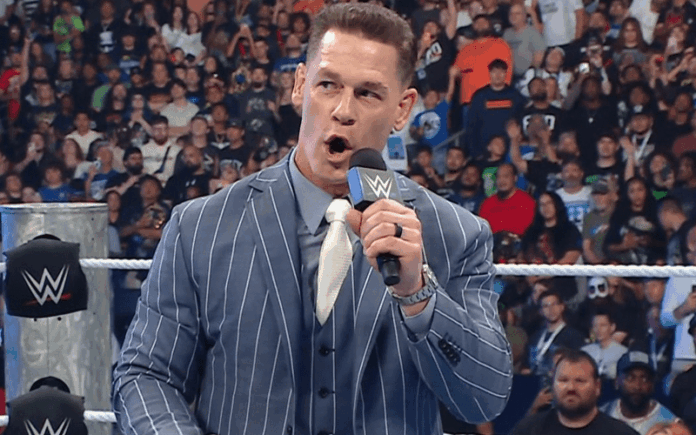
John Cena believes WWE’s transition to PG programming played a major role in changing the public perception of professional wrestling, although he acknowledged that the benefits of the company’s rebranding took more than a decade to fully materialize.
During an appearance on What Now? with Trevor Noah, Cena discussed WWE’s decision to move away from its TV-14 presentation in 2008 and embrace a more family-friendly product.
The former WWE Champion explained that the transition required patience, with the company gradually establishing a new identity and expanding its appeal beyond wrestling’s traditional audience.
“It rebranded itself. And when you rebrand, it takes 10, 15 years to get over. We got over, and I was happy to be involved in a lot of that rebranding process.”
Cena reflected on how WWE’s presentation evolved across different generations, from Hulk Hogan’s family-oriented image in the 1980s to Stone Cold Steve Austin’s rebellious character during the Attitude Era.
He explained that the arrival of more families during his own rise to prominence influenced WWE’s decision to adjust its programming.
“The ’80s Hulk Hogan was nationalist, virtuous, say your prayers, eat your vitamins, do good. And then Stone Cold Steve Austin, the Raw era, was drink beer, flip off your boss. We are programming to an 18-year-old male. And then more families start to show up around the time that I started. So we switched to, literally, we changed the rating of the program to PG, which means some of the stuff we can’t do. Blood is no longer a thing.”
According to Cena, adopting a PG rating allowed WWE to make its programming more accessible to audiences worldwide, helping the company expand its international reach.
He also credited the rise of social media and digital content with changing how professional wrestlers were perceived by the general public.
Cena recalled a time when wrestlers struggled to receive the same recognition as traditional athletes or actors, with professional wrestling often dismissed as a niche form of entertainment.
“It used to be like you were in movies or you were in television, you were an actor. You played pure sport, you were an athlete. Wrestlers were none of that. They’re just carnies. Like, we used to be just carny folk. And then everybody started making content, and there became multiple lanes to success, multiple lanes to relevancy, to resource. So it’s like, ‘Oh man, these people have a voice, and they have influence.’ WWE was on the cusp of all that, and our social accounts are off the charts.
“Our audience is super engaging. You can’t ignore the math. You can’t ignore the data. It also became okay to be in the crowd for a wrestling match. It used to be a thing of, ‘I’ve seen it, but I don’t watch that stuff.’ And now it’s like, ‘I’m going.’”
Cena believes the combination of WWE’s rebranding, social media growth and changing cultural attitudes helped make professional wrestling more socially accepted.
He also pointed to the lasting connections WWE has developed with its audience, noting that many fans who watched him perform as children are now attending events with families of their own.
“So we’ve just been around long enough after all these tectonic shifts and changes where people are like, ‘No, no, it’s fine, it’s cool.’ And a lot of things happened in society to open doors for us.”
Cena retired from in-ring competition in December 2025, concluding a career that saw him become one of the defining figures of WWE’s PG Era.
The WWE legend also recently announced that the John Cena Classic is scheduled to take place this December.
His full conversation with Trevor Noah is available on the What Now? with Trevor Noah podcast.