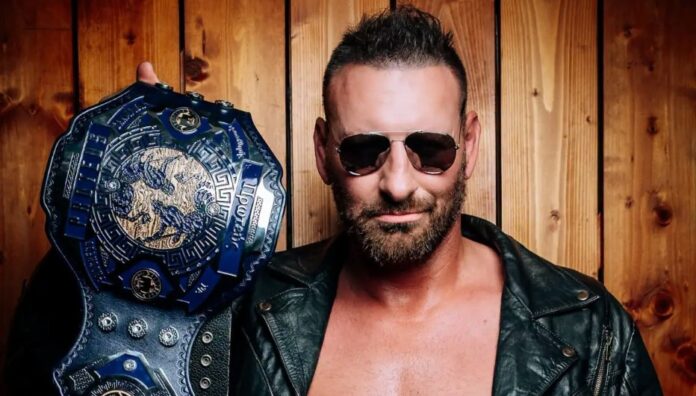
In an exclusive interview with PWMania.com, former WWE star and current PROGRESS Proteus Champion Donovan Dijak discussed his experiences working with Vince McMahon, Triple H and Shawn Michaels, revealed previously untold details about his rivalry with Keith Lee, and reflected on his time as T-BAR in RETRIBUTION.
Dijak also discussed his return to PROGRESS Wrestling, where he recently defeated Hollywood actor Paul Walter Hauser at Chapter 199: Bonestorm to capture the Proteus Championship. The victory marked a return to London’s Electric Ballroom, a venue where he made a surprise appearance more than a decade earlier.
During the conversation, Dijak shared his memories of approaching Vince McMahon’s office uninvited, explained why Keith Lee personally requested their NXT rivalry, and compared WWE’s creative processes under different leadership teams. He also outlined his ambitions for PROGRESS and the championship he now holds.
Watch the complete exclusive interview below:
From Camden to Championship Gold
Dijak’s return to PROGRESS Wrestling came together relatively late, with the former WWE star already planning to spend time in the United Kingdom. His friendship with Big Damo helped make the opportunity possible, while a match against Paul Walter Hauser was something both men had wanted for some time.
“It turned out that there was an opportunity to make this match happen. It’s a match that both myself and Paul have wanted to do for a very long time. And I’m very lucky and fortunate that I was able to do it under those incredible circumstances at the Electric Ballroom.”
Dijak praised Hauser’s dedication to professional wrestling, noting that the actor’s enthusiasm goes beyond simply making occasional appearances in the ring. Having spent time around Hauser in MLW, Dijak was familiar with his passion for the business and appreciated the opportunity to work together in a more storyline-driven environment.
“He’s a passionate human being. He loves professional wrestling. Obviously, there’s no real need for him to do any of this professional wrestling. Every second he steps in the ring, he loves doing it. Every time he comes out to meet the fans, he loves doing it.”
Returning to the Electric Ballroom also brought back memories of his first PROGRESS appearance, when he faced Pete Dunne. Both appearances were surprises, and Dijak recalled the uncertainty of waiting backstage without knowing how the audience would react.
“There was a decade apart standing behind probably not the exact same curtain, but in the exact same spot, knowing that the crowd isn’t going to know who’s coming out next. And then, you know, 10 years apart, there’s always that question in the back of your mind. You’re like, ‘I think they’ll recognize me and be happy,’ but you’re never quite sure until it happens. And the first time was a great reaction. The second time was even better.”
Wanting To Make The Proteus Championship PROGRESS Wrestling’s Top Title
Dijak made clear that his ambitions extend well beyond simply holding the Proteus Championship. He wants to increase the title’s visibility, defend it regularly and establish it as the championship that wrestlers and fans associate most closely with PROGRESS.
“The second that this championship was put on my shoulders, I felt an overwhelming drive to make sure that I leave it better than I found it. So my goal is to make this the top championship in PROGRESS. My goal is to give this championship the most visibility in PROGRESS, to bring this championship in a direction that makes it the number one championship.”
He explained that his intentions were clear from the moment he first held the title, adding that he wants to use both his performances and his influence behind the scenes to help elevate its standing.
“This is the championship that I want everyone thinking about and coveting when they come to professional wrestling. So I’m going to give it the visibility that it deserves. I’m going to give PROGRESS the visibility that it deserves. I’m going to defend as much and as often as I possibly can, and I’m going to give everything that I have in all those matches.”
Dijak acknowledged the Proteus Championship’s history of allowing its holder to influence match stipulations, although he was unsure whether that approach would continue during his reign. Regardless of the direction taken, he said he intends to put his full energy into making the championship feel important.
Keith Lee – A Rivalry That Almost Never Happened
Dijak’s matches with Keith Lee remain among the highlights of his WWE career, with the two combining remarkable athleticism and power to produce some of NXT’s most memorable encounters. However, Dijak revealed that their rivalry nearly never happened, as he initially selected a different opponent when Beyond Wrestling offered him a choice of matches in January 2016.
The promotion had asked whether he wanted to face Big Damo or Keith Lee at an event in Rhode Island. Having recently wrestled Damo in England, Dijak initially chose to face him again before reconsidering a few days later.
“I remember Drew messaged me and he asked me, ironically, whether I wanted to wrestle Damo or Keith. And I had just wrestled Damo in England. This was January of 2016. And so I said, ‘Oh, I loved wrestling Damo. I’ll wrestle him again.’ And then like two or three days went by and I was like, ‘Man, you know what? I already wrestled Damo. Let me wrestle this other guy, Keith Lee, instead.'”
Dijak recalled that their chemistry became apparent almost immediately when they began discussing what they could do in the ring. One suggestion in particular caught him off guard, with Lee proposing a standing moonsault despite his considerable size.
“What if after I knock you down, I give you a standing moonsault?” Dijak recalled Lee suggesting. “And I just looked at him. You know, this is a 6’4″, 350-pound guy. He’s just straight muscle. And I’m like, ‘I’m sorry. Did you just say a standing moonsault?'”
After learning about Lee’s athletic background, Dijak began suggesting other moves and quickly realised the possibilities were almost limitless. Their first match became an immediate success, with Lee winning over a crowd that had initially been firmly behind Dijak.
“The match we ended up having was just a complete showcase of his strength, athleticism, everything. And he obviously took the ball and ran with it. He connected with the audience almost immediately. If you watch the match, it’s very funny because I was the quote-unquote top guy. They called me the ace of Beyond Wrestling.”
Dijak explained that the crowd began chanting his name before quickly embracing Lee as well. By the end of the match, Lee had received a standing ovation and chants encouraging him to return, establishing a partnership that would continue across the independent wrestling scene.
Their rivalry subsequently took them around the United States and Europe, with Dijak estimating that they wrestled approximately 11 times before joining WWE. He attributed their chemistry to their shared commitment to delivering the best possible performance, combined with their unusual physical abilities.
“There’s nobody else on the planet where I can dive over the top rope and they can catch me out of midair. Just no one else can do that, right? He can. So that in and of itself led to a hundred different options of cool things and cool visuals that we could do, and we were always willing to adjust something or try something new or give it a new coat of paint or whatever.”
Keith Lee Personally Requested Their NXT Rivalry
Despite their success on the independent scene, Dijak revealed that WWE initially had no plans to establish a lengthy rivalry between the two. Lee had been working with other opponents following his arrival in NXT, but eventually approached Triple H about being paired with Dijak.
“Keith told me straight up, he told Hunter like, ‘Hey, just put me with Dijak, please.’ And I was specifically told from the office that it was supposed to be a one-off.”
Dijak recalled being informed by NXT’s lead writer, Joe Belcastro, that he and Lee would have one match before Dijak moved into another storyline. However, the reaction backstage following their first television encounter quickly changed those plans.
“They told me the day of. I remember the exact conversation I had with the lead writer Joe Belcastro. He told me straight up, he’s like, ‘Hey, we’re going to run you and Keith just one time and then we’re going to move you into this program. We’re going to do this, this, this, and this with you.’ And I was like, ‘Cool. Sounds good.’ And we had that match and we came to the back and they were head over heels about it. They were like, ‘We are doing this over and over and over.'”
Their rivalry subsequently became a major part of NXT programming, with Lee going on to capture both the NXT North American Championship and NXT Championship. However, Dijak admitted that the final match between them wasn’t the conclusion either wrestler would have wanted.
“Unfortunately for he and I, the last time we wrestled was in like an eight-man tag on Monday Night Raw where he was Bearcat and I was T-BAR. So not really the ending that we wanted for that, but hopefully we get to do it again and put a good sort of bookend on the end of it.”
RETRIBUTION – More Than Just T-BAR
RETRIBUTION remains one of WWE’s more divisive creative decisions, but Dijak revealed that he actively pursued the opportunity to become involved with the faction. Although he wasn’t part of its earliest appearances, he approached Vince McMahon about joining the group and suggested several other wrestlers who could potentially be included.
“That was when I sort of pitched to Vince to include me in it, and I had some other ideas for people that I wanted in it. Damo was actually one of them, which didn’t end up happening. Nikki was one of them too, but the people who ended up in there were also on my list of people that I wanted included. I can’t tell how much of my idea Vince took and how much was his own idea and how he mixed and matched them.”
Dijak acknowledged that RETRIBUTION struggled to maintain its early momentum, particularly following changes to the group’s presentation and its eventual rivalry with The Hurt Business. Nevertheless, he believes the experience provided opportunities that were especially valuable during the uncertainty of the COVID-19 pandemic.
“I was very thankful for it because it was at a time during COVID when lots of people around the world were getting sick and getting fired and losing work and things like that. Even people in WWE were getting sick and getting fired. And I was fortunate to just have a job. I was not only in a job, but a significant promotion really when you look at it.”
He also appreciated the chance to share a locker room with established WWE stars, including Randy Orton, John Cena, Roman Reigns and Edge, whose experience he could learn from. Rather than dwelling on the criticism surrounding RETRIBUTION, Dijak believes that period ultimately helped establish his future career.
“People think of it like, ah, that tainted your career and it sent you on a downward spiral or whatever. That’s just not the case. I was on a main roster contract. I was able to parlay that into my best run ever, which was the Dijak character on NXT. That was all under the same contract.”
Dijak explained that his later NXT run helped him transition successfully back to independent wrestling, allowing him to continue making a living in the industry after leaving WWE. He credited the exposure he received on national television with giving him a platform that remains valuable today.
Walking Into Vince McMahon’s Office
One of the most revealing parts of the interview concerned Dijak’s determination to secure opportunities during his WWE main roster run. He recalled how dramatically his career changed throughout 2020, beginning the year as Dominik Dijakovic in NXT before eventually becoming T-BAR in RETRIBUTION.
Between those two points, he experienced several changes in direction, moving between NXT and Monday Night Raw while spending months without a clear role on television. Rather than waiting indefinitely for creative plans to develop, Dijak decided to approach McMahon himself.
“If I’m going to go down, I’m going to go down swinging, right? I’m not just going to fade into oblivion. I’m going to shoot my shot. So eventually I just kind of went into Vince’s office uninvited. It didn’t go well the first time. The second time went a little better, I think. It ended with RETRIBUTION. It ended with some opportunity, and I tried to do the best with that opportunity that I was given.”
Dijak explained that he was more willing than many other wrestlers to approach McMahon directly, particularly when he felt his career wasn’t moving in the right direction. However, establishing a meaningful working relationship with the then-WWE Chairman proved difficult.
“I knew wrestlers who had been there for decades and never approached Vince. They just kind of hoped that it went well, which is fine. That’s an approach that you can take and sometimes it works, sometimes it doesn’t. For me, I sort of started to see things not trending in my direction. I said, ‘You know what? I’m just going to pitch and talk and as much as I possibly can try to create a relationship.’ It was hard. I’m not going to lie. It was hard.”
During his two years on the main roster between 2020 and 2022, Dijak estimated that he had only six or seven substantial conversations with McMahon outside routine interactions during television production.
“I had like a real conversation with Vince probably like, I don’t know, six or seven times throughout the two years I was there. Sometimes they were lengthy conversations, sometimes they were shorter conversations. Was he easy to talk to? I guess like easy in the sense that he wasn’t angry or anything like that, but also difficult in the sense that as T-BAR, I would get the feeling that he’s just kind of trying to get me out of the room.”
Dijak said he continued presenting ideas in different ways, sometimes explaining them verbally and other times preparing written material. However, he felt that McMahon preferred creative concepts to originate from his own vision rather than having ideas presented to him by performers.
“I think the ideas at the end of the day had to be his. You can’t give Vince an idea and convince him that it’s his own. He needs to have the idea originally and then if you agree with it, great, we’ll run with it or whatever.”
Despite those frustrations, Dijak stressed that McMahon was never personally hostile towards him. His difficulties were primarily related to communication, creative direction and the challenge of securing attention within WWE’s main roster environment.
“He was never like mean or negative to me. It just felt like he had better stuff to do, for lack of a better term, which obviously he did. But yeah, for me, I’m like Captain Scratch and Claw. I’ll do anything to try to get some sort of notice.”
Working With Vince McMahon, Triple H And Shawn Michaels
Dijak also discussed the differences between working under Vince McMahon and his experiences with Triple H and Shawn Michaels in NXT. While he acknowledged that every booker has their own creative vision, he felt the communication process was considerably more collaborative during his time with WWE’s developmental brand.
“It was a little bit easier with Hunter. Easier to talk to him. It felt like he was listening and being collaborative. At the end of the day, every booker, every writer is going to have their own vision, right? And my job isn’t to invade their process and be like, ‘No, do this instead.’ My job is to figure out what they want out of me and try to contribute to that thought process.”
Dijak explained that Triple H and Michaels were more transparent about their creative plans, allowing performers to understand the intended direction before contributing their own suggestions. He particularly appreciated the ability to collaborate on match ideas while respecting the overall structure of WWE’s television programming.
“With Hunter, he was a lot more transparent. Shawn, too, a lot more transparent about like here’s what my vision is, here’s what we’re trying to get to. And then I could try to make little adjustments. And same with the other direction, right? I could bring them an idea, especially a match idea.”
He also emphasised that WWE’s creative process involves more than simply writing individual segments, with every storyline and match needing to fit within the wider television programme. For that reason, Dijak preferred to understand the direction being taken before suggesting ways to improve it.
“For me, I would wait to figure out what their idea and their direction was first and then go, ‘Oh, how can I make that even more creative? How can I take their idea and improve it?'”
According to Dijak, that approach helped establish a productive relationship with NXT’s creative team, particularly when it came to developing matches and making adjustments to existing plans.
Triple H Taking Over WWE Creative
Dijak also provided a firsthand account of WWE’s creative transition in 2022, revealing that he was present for Vince McMahon’s final Monday Night Raw before his initial retirement and Triple H’s first episode overseeing the main roster.
He recalled sitting in the front row during the talent meeting when Triple H addressed the roster about the leadership changes and explained the new management structure.
“I was on Monday Night Raw for Vince’s last Monday Night Raw and I was there the next week for Hunter’s first Monday Night Raw. I was sitting in the front row when he walked into the talent meeting and was like, ‘Hey, I’m in charge now.’ And he didn’t say, ‘I’m in charge now,’ but it was that sort of Vince wants to retire and here’s who you should see this person for this and you should see me for this.”
Although Dijak remained on the main roster for only a relatively short period after the transition, he noticed differences in the working environment. He felt that Triple H’s initial approach was closer to what he had experienced during the black-and-gold era of NXT than the system he had worked under during McMahon’s leadership. However, Dijak was careful not to speculate about WWE’s current creative structure or the influence of TKO, acknowledging that his own experience of Triple H’s main roster leadership was limited.
“I don’t know how much oversight TKO contributes now or how much the board is influencing or whatever. I can only speak from an outsider perspective, and the short answer to that is I have no idea.”
What Dijak did emphasise was Triple H’s passion for professional wrestling, expressing confidence that he remains committed to delivering the strongest possible version of his creative vision.
PROGRESS – The Next Chapter

With Chapter 200 approaching, Dijak believes PROGRESS is heading in an exciting direction under Nikki Storm and Big Damo. He recalled attending a PROGRESS show during WrestleMania weekend in 2016 and being impressed by the atmosphere, particularly the enthusiasm of the crowd compared with other events taking place at the same venue.
Dijak explained that he sees the promotion’s previous success as a benchmark worth pursuing, while praising the current management team for rebuilding momentum and creating an environment that performers and fans are excited to be part of.
“The PROGRESS show, by leaps and bounds, the most sold out I’ve ever seen that building. The crowd was absolutely electric for that show. So the fact that PROGRESS was at that level at that point in the timeline, that’s something that I hold in very high regard. And that’s kind of where I view PROGRESS right now in terms of what we want to achieve and what we want to exceed.”
Dijak also discussed how his approach to creative involvement changes depending on the promotion he’s working for. While he is generally happy to trust smaller independent companies with their booking decisions, he becomes more involved when performing on larger platforms where his presentation can reach a wider audience.
“My goal is always to elevate the brand, right? Elevate the product. So that’s kind of how I view myself. And obviously the more that you invest into not just me, but the brand itself and the talent itself, the more I’m going to have a drive to join you on that mission.”
Looking ahead, Dijak identified Simon Miller as one potential opponent he’d like to face in PROGRESS, while expressing particular interest in wrestling larger, athletic competitors who can provide new challenges.
He explained that although working with smaller wrestlers can sometimes be easier because of the natural size difference, he has reached a stage in his career where he actively seeks more difficult and unusual matchups.
“I’ve gotten to the point in my career where I don’t really like easy things. I like difficult things and challenges and unique things. So that’s kind of where my mindset is now.”
With the Proteus Championship around his waist and plans to continue working with PROGRESS into 2027, Dijak is focused on making the most of his latest opportunity. His experiences in WWE, his rivalry with Keith Lee and his return to the independent wrestling scene have all helped shape his approach, but his immediate priority is making the championship and the promotion as successful as possible.
For Dijak, returning to Camden isn’t simply about revisiting the past. It’s about helping build PROGRESS Wrestling’s future.