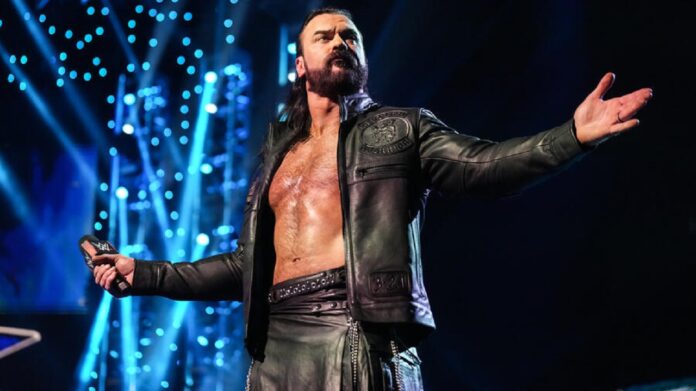
WWE Superstar Drew McIntyre has shared his thoughts on how professional wrestling matches should be structured, explaining why he dislikes performers who plan every detail of their matches in advance.
During an appearance on Bradley Martyn’s Raw Talk podcast, McIntyre discussed the importance of adapting to the live audience rather than relying entirely on a predetermined sequence of moves.
The former WWE Champion acknowledged that certain situations, particularly those involving stunts, require rehearsal. However, he believes experienced wrestlers should be capable of working through a match without scripting every moment.
“Unless it’s stunt practice, but when it comes to the matches, you should know what you’re doing. We could talk about it a bit.”
McIntyre explained that wrestlers should establish a general direction for their matches while remaining flexible enough to adjust based on the crowd’s reactions.
“You got 10 minutes, you got 15 minutes, you got 20 minutes. Go out there and listen to the crowd. Wrestle. I can’t stand when people plan stuff from beginning to end because you don’t know how the crowd’s going to react.”
According to McIntyre, one of the biggest challenges arises when a performer struggles to adapt after something in the match fails to generate the expected response.
He noted that while many wrestlers are comfortable making adjustments in real time, others can become overwhelmed when plans change during a live television broadcast.
“A lot of people are good at listening, but some people panic, and it’s not fun if you’re on live TV and somebody panics and you’re talking to them like, ‘Hey, this ain’t working. We’re going to go this direction now.’ And they kind of freeze up, and that’s when things look choppy. Not choppy in the good way.”
McIntyre also distinguished between the physical, unpredictable appearance of a convincing wrestling match and the awkwardness that can result from miscommunication between performers.
“I like it if it looks kind of real, if it’s kind of choppy and you get really physical with each other. But if things start messing up in an obvious way, it’s not good. If there’s a miscommunication or somebody’s trying to tell the other person, ‘Let’s go this direction,’ and they’re not quite ready.”
McIntyre’s comments highlight his preference for an adaptable, physical style of wrestling that allows performers to respond naturally to the audience while maintaining communication inside the ring.
For McIntyre, the ability to improvise and recognize what is working with the crowd is an essential part of delivering a convincing professional wrestling match.