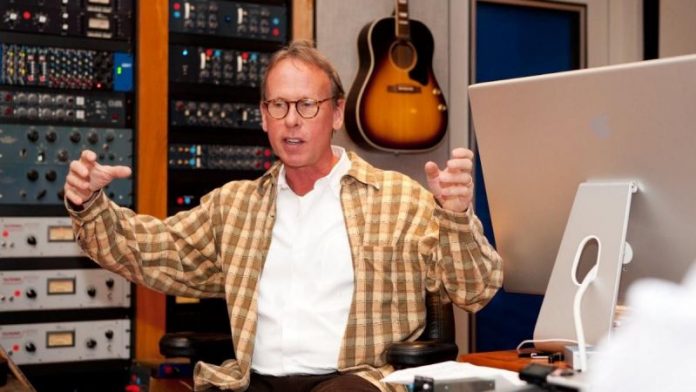
Legendary WWE composer Jim Johnston, the creative force behind many of professional wrestling’s most iconic entrance themes from 1985 until his departure in 2017, recently appeared on The False Face podcast for an extensive interview covering his career, the origins of legendary entrance music, and his thoughts on the current wrestling landscape.
During the nearly two-hour conversation with host Paul McNamee, Johnston challenged Steve Austin’s long-standing account of how the “Stone Cold” theme was created, revealed that Brock Lesnar’s entrance music was originally composed for the XFL, discussed his creative philosophy, and shared why he believes neither WWE nor AEW is producing stars on the level of previous generations.
For years, Steve Austin has recalled bringing Rage Against the Machine’s Evil Empire album to Johnston as inspiration for his entrance music, specifically citing “Bulls on Parade.”
Johnston, however, said he doesn’t remember that happening. “I’m not sure that ever happened.”
According to Johnston, the music was actually created before he had even met Austin, originating as part of a series of vignettes designed to introduce the emerging “Stone Cold” character after his Ringmaster persona.
“The creation of that theme happened way before I ever met Steve, because it started with his promos. There were a series of promos when they transitioned him from Ringmaster, and these two producers, friends of mine, David Sahadi and Chris Chambers, who did some unbelievably creative stuff, they had this idea for a series of things that they shot up in this really beat up, dark, destroyed warehouse in upstate Connecticut, and they were almost poetic. I remember one final line was Steve saying something like, ‘You want forgiveness? Go to church.’”
He explained that the now-famous musical hook was originally intended as the dramatic payoff to those promo packages. “At the time, I saw the vibe of the promos, and what I came up with, the first version of Steve’s theme, was a score for those promos. I did sort of orchestral type stuff for 90 percent of the promo, and each one of them had a tagline, and boom. It needed something that kind of kicked you in the ass, and that’s when I came up with it.”
Johnston also noted that the iconic glass-shattering sound effect was already part of those original promos.
While he acknowledged Austin may have later suggested tweaks to the music’s energy, Johnston believes the foundation had already been established. “Maybe he came to me later, either directly or indirectly, and said, this is the energy I want. But so maybe he didn’t like the first version or something.”
When McNamee joked that Austin should weigh in, Johnston laughed. “Yeah, Steve, you pain in the ass, trying to bury me.”
Johnston didn’t hold back when discussing modern wrestling entrance themes, arguing that today’s music lacks individuality and has contributed to a decline in genuine superstar creation.
“It just sounds like noise to me, and all the themes just sound generic. It used to be, whether it was my music or a Jimmy Hart theme or an outside band thing, you used to be able to be making dinner in the kitchen with the TV in the other room, and you’d know who was coming out. You could almost follow the program from the other room. Now, I just don’t think it’s like that at all. And for some reason, the powers that be have forgotten their roots or something, of how powerful music is in creating stars. And I further believe that’s why they’re not creating, either WWE or AEW. They’re not creating big stars anymore. There are no new Steve Austins. There are no Rocks around now. And it’s because everyone’s sort of in this layer of generic.”
He added that large companies often become complacent after finding financial success. “I think that happens to a lot of corporations. They find what works. They’re making a lot of money. And, oh well, we must be doing it right. So don’t change anything.”
Johnston contrasted that mindset with Vince McMahon’s willingness to constantly evolve WWE’s presentation. “He was always trying to push the envelope forward. Sometimes he pushed it places that I certainly didn’t agree with. But at least the guy was embracing progress and change, and how can we make the product even better than it was yesterday. And that was a compatibility that he and I really had, because I always wanted to try different things and make the music better.”
One of the interview’s biggest revelations involved Brock Lesnar’s iconic entrance music.
Johnston confirmed the theme wasn’t initially composed for Lesnar at all—it was written for the XFL’s Chicago Enforcers. “I wrote it for the XFL.”
Reflecting on the original football venture, Johnston praised several innovations introduced by the league despite its commercial struggles. “The whole XFL thing was awkward at best,” he said. “I get what Vince was trying to do, and he had a much bigger impact on the world of professional football than he ever thought he was going to have, in that the vast majority of innovations that came to pass in XFL, in terms of camera coverage, the cameras flying above the stadium, and much more character development, learning much more about these people, that is the NFL playbook now. I wrote themes for all those teams, and it was a great effort, but it just never sort of clicked. And when Brock showed up, it isn’t like I suggested that. It’s just like suddenly that music showed up for Brock.”
Johnston believes the theme ultimately found its perfect performer.
“Sometimes the stars align. Maybe, going back to truth, that music finds its rightful home, because that is perfect for Brock.”
He compared the situation to Hulk Hogan’s famous “Real American” entrance music, noting it was originally created for The U.S. Express before becoming synonymous with Hogan.
Despite composing themes for countless WWE Superstars, Johnston admitted he intentionally avoided watching much of the product and often had minimal interaction with the performers themselves.
He explained that he usually received only brief character descriptions before being left to create the music. “They would be writing the shows right up until the show went live, and sometimes after,” he said. “They didn’t even know what the final match of the night was going to be. Because of that, new people would be introduced suddenly. Someone may change from a babyface to a heel. Maybe two guys suddenly are a tag team because of a story change.”
Johnston also recalled frequently disagreeing with longtime WWE executive producer Kevin Dunn over whether he needed to follow the television product. “This was an eternal argument I had with my boss, who was the executive producer, Kevin Dunn. He was always, ‘Jim, you have to watch the programs,’ and I just resisted, probably first and foremost because I’m not a wrestling fan. I didn’t really want to watch the programs, but I think it was curiously one of the most valuable things, my separation from it.”
Instead, he approached every wrestler as though he were composing a film score. “I always approached it as nothing but a movie score to these individual guys. Each of these guys is their own little film. They’re the Harrison Ford or Brad Pitt of that film, and I’ve got to do the main theme to that film that makes you think of that film when you hear it.”
Johnston also explained why he generally avoided collaborating directly with talent when creating entrance music. “I have had very little interaction with the talent. That was absolutely by choice, because it always ended badly.”
According to Johnston, many wrestlers wanted entrance themes based on their personal music tastes rather than what best suited their characters. “If I had to deal with talent, I would inevitably hear either two lanes,” he added. “One is, well, I love Metallica, so I’d like it to be kind of a Metallica vibe. Or it’s, I love Stone Cold’s music, I love that whole attitude. And of course, the first thing I want to say is, well, there’s only one problem with that: you’re not Steve Austin. Part of that magic is Steve. He dances with that music perfectly.”
Elsewhere in the interview, Johnston revealed that he often pushed back against automatically assigning hip-hop themes to Black wrestlers, arguing every performer deserved music that fit their individual character rather than stereotypes.
He also discussed recording the iconic D-Generation X entrance with vocalist Chris Warren, recalled working with Motörhead and Lemmy on Triple H’s music, confirmed the samples in Scotty 2 Hotty’s theme came from licensed commercial sample libraries rather than existing recordings, and shared stories behind The Undertaker’s evolving entrance music.
Johnston admitted he disliked recreating library music after WWE decided to move away from stock tracks for business reasons and revealed he always believed villains should receive memorable, powerful themes rather than intentionally “bad” music.
Finally, he noted that despite composing some of the most recognizable entrance themes in wrestling history, he has never experienced writer’s block.
Instead, his biggest challenge has always been staying focused on one idea before another inspiration arrives. Johnston also confirmed he still possesses the original master recordings for his WWE compositions, including the earliest demo ideas captured on a handheld recorder.